
Toenail fungus often starts small, You may not notice the early signs.
There might be a faint yellow spot, a slight thickening along the nail edge, or a subtle color change. But over time, the nail can become discolored, brittle, or crumbly.
Many people start with an over-the-counter treatment, hoping for a quick fix. If that doesn’t help, they try another option, and then another. Eventually, they come across laser treatment for toenail fungus and find themselves with a whole new set of questions.
What does laser surgery entail? Will it get rid of the fungus? Will it come back?
Here we will go through the frequently asked questions so you know what to ask before scheduling your first laser toenail fungus appointment. You can walk into that meeting feeling informed and prepared for what comes next.
How Does Laser Treatment for Toenail Fungus Actually Work?
Toenail fungus, or onychomycosis (on-ih-koh-my-KOH-sis), is caused by tiny fungi called dermatophytes. These organisms settle beneath your nail and feed on keratin, the protein that makes up your nails.
The reason toenail fungus can be so difficult to treat is that the nail itself acts like a protective barrier. Many topical treatments can’t reach deep enough to get to the source of the infection. Oral antifungal medications can reach it through the bloodstream, but they aren’t the right choice for everyone.
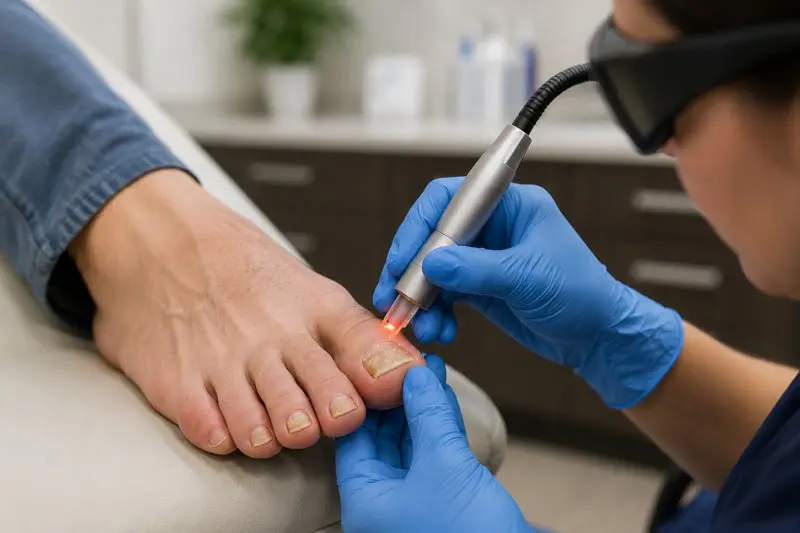
Laser treatment works a little differently. A focused beam of light passes through the nail and into the nail bed, where it creates heat that damages the fungal cells. The laser is designed to target the fungus while leaving the surrounding skin and healthy nail tissue unharmed. You can think of it as a highly targeted treatment that focuses on the infection without affecting the surrounding areas.
Your podiatrist can perform the procedure right there in their office. There’s no anesthesia, no cutting, and usually no downtime afterward. Most appointments are finished in less than an hour, though the exact time depends on how many nails need treatment.
Does Laser Toenail Treatment Hurt?
When you hear the word laser, the first thing you think of might be a comic book super villain, or a space-age phaser. With those thoughts in mine, you may be a little uneasy about aiming a laser at your body.
But most patients say the treatment feels like a mild warmth, a light pulsing sensation, or an occasional tingle. Considering what the word laser might make you imagine, the experience is usually much easier and less dramatic than expected.
If you have thicker nails or a more advanced infection, you may notice a bit more warmth during the session, but it typically lasts only a moment.
There are no needles, no stitches, and no recovery days spent resting with your foot propped up. You come in for your appointment, complete the treatment, and get right back to your day. For most people, it’s a simple and straightforward process.
If you’re concerned about discomfort, don’t hesitate to bring it up before treatment begins. Your podiatrist can explain exactly what to expect based on your condition and make any needed adjustments to help you stay comfortable from start to finish.
How Many Sessions Will You Need?
One of the most common questions patients ask during their first consultation is “How many treatments will I need?” The answer is usually, “It depends.”
The number of laser treatment sessions you’ll need can vary based on how many of your nails are affected, how advanced the infection is, and how your nails respond to the initial treatment.
Most people need between two and four sessions, typically scheduled several weeks apart. If you catch the infection early, fewer treatments may be enough. More severe or long-standing infections often require additional sessions. Your St. George podiatrist will assess your nails at the start of treatment and monitor your progress to determine the best plan for you.
It’s helpful to have realistic expectations from the start. Laser treatment isn’t usually a one-and-done solution. Instead, it’s a gradual process. The results unfold over multiple sessions, with each treatment building on the gains of the previous one. Patients who understand that tend to stick with their treatment plan, which can play a big role in achieving the best possible outcome.
How Long Until You See Results?
Treating toenail fungus takes a bit of patience, no matter which method you use. Toenails grow very slowly, about one millimeter each month. So even if laser treatment eliminates the infection at its source, you should not expect to see a perfect new nail overnight. Healthy nail tissue needs time to grow in and gradually replace the damaged portion.
Most people start to see a noticeable improvement a few months after treatment. It can take up to a year for a completely clear, healthy nail to grow in, depending on your natural nail growth rate and how much damage the infection caused in the first place.
One of the first encouraging signs is fresh growth at the base of the nail, which appears clear and smooth. That healthy strip shows that the infection is responding to treatment and that new nail tissue is replacing the damaged tissue. Your feet will make progress; they are just doing it on their own timeline.
Can the Fungus Come Back After Treatment?
Unfortunately, yes, your fungal infection can return.
Laser treatment can clear an active fungal infection, but it does not make you immune to getting another one later. The same things that helped the fungus develop in the first place, such as warm, damp shoes, shared surfaces at pools or gyms, or tiny openings in the skin around the nail, can still create an opportunity for it to come back.
The good news is that a few simple habits can make a big difference in preventing a recurrence:
- Dry your feet thoroughly before putting on socks or shoes, especially between the toes.
- Wear moisture-wicking socks and alternate your footwear so each pair has time to dry out between uses.
- Use sandals or flip-flops in locker rooms, shared showers, and around pool decks.
- Replace older shoes that could still contain fungal spores.
- Trim your toenails straight across and keep them at a comfortable length.
If fungal infections keep returning, speak with your podiatrist about possible underlying causes. Issues such as poor circulation or changes in immune function can sometimes increase the risk of infections. Identifying any contributing factors can help improve the chances of long-term success.
Is Laser Treatment the Right Option for You?
Laser treatment is often a great option for people who have already tried topical treatments without success, want to avoid the potential side effects of oral antifungal medications, or have health conditions that make oral medications less suitable.
Of course, it is not the only effective treatment available. Mild infections caught early can often improve with a good topical antifungal, especially when used consistently. Oral antifungal medications are also proven treatments that work well for many patients. In some situations, the best results come from combining multiple treatment approaches rather than relying on a single approach.
The best treatment for you depends on several factors, including the type of fungus involved, the extent of the infection, and your overall health. Your provider will also factor in any treatments you have already tried.
It is also important to confirm that the fungus is actually the cause of the problem. A fungal infection isn’t always the cause of changes in nail appearance. Conditions such as psoriasis, nail trauma, and other nail disorders can look very similar, and treating the wrong condition can lead to unnecessary expense and frustration.
A thorough evaluation by a podiatrist is the quickest way to get clear answers about what is affecting your nail and which treatment approach is most likely to deliver the best results.
Don’t Keep Your Toenails Waiting
Toenail fungus usually does not go away on its own, and if left untreated, the infection can gradually spread to nearby nails. The longer the infection remains, the more difficult it can become to manage and the greater the chance that it will affect additional nails.
If you are ready to get a professional opinion, make an appointment with a local podiatrist. They will take the time to evaluate each case individually, explain what is causing the problem, and review all available treatment options, including laser therapy.