

Foot and ankle discomfort can be easy to ignore at first. You might try walking it off, switching to a different pair of shoes, taking an anti-inflammatory, or simply hoping it gets better with time.
Sometimes that’s all it takes.
But if the pain keeps coming back, spreads to other areas, or begins affecting your daily routine, consider a more specialized approach.
The feet and ankles are some of the most complex parts of the body, with dozens of bones, joints, muscles, and ligaments working together every day. Finding the real cause of the problem often requires help from a foot and ankle specialist to figure out what’s happening.
Why Foot and Ankle Conditions Need Focused Care
Your foot has 26 bones, 33 joints, and more than 100 muscles, tendons, and ligaments, and that’s before even including the ankle.1 All of these parts work together in a carefully timed sequence every time you take a step. When something is off in one area, it can affect surrounding soft tissue and bones.
What feels like simple heel soreness might be a bone spur, stress fractures, Achilles tendinitis, or even a mix of several issues. What appears to be a lingering ankle sprain may indicate ligament damage that, if left untreated, can lead to ongoing joint instability.
Foot and ankle conditions often overlap and the symptoms can be similar. And because the foot is connected to a larger chain running through the knee and hip, a problem in one place can quietly create stress somewhere else.
Your body is incredibly good at adapting. When something hurts, it shifts the load to nearby structures to protect the painful area. If your arch collapses to ease heel pain, your ankle takes on more stress. If your ankle is unstable, your knee ends up compensating. Over time, those adjustments can create new issues, often before you realize the original problem is still there.
Treating what you feel on the surface without understanding what’s happening underneath is one of the biggest reasons foot pain lingers. That’s why focused expertise matters when sorting through that complexity.
What a Specialist Focuses On
The main difference between a general provider and a foot and ankle specialist is their depth of knowledge. A specialist trains specifically to evaluate and treat conditions affecting one area of the body. That means they see a much higher volume of foot and ankle conditions. They have experience with the subtle symptoms that may not be as apparent to a general practice physician.
That experience carries over into a strong understanding of how your foot, ankle, and lower leg all work together when you move. A specialist can often watch you walk, notice small compensations, and connect those movement patterns to the structures they’re affecting.
They might see your arch dropping on one side during push-off, your heel striking in a way that places uneven stress on the plantar fascia, or your ankle rolling inward at a specific point in your stride that’s irritating a nerve. These are details that are easy to miss in a general exam but much clearer to someone specially trained to look for them.
Going to a dedicated foot and ankle center also gives you access to a broader range of targeted treatment options. From custom orthotics and specialized physical therapy to in-office procedures and surgical care when needed, the treatments available are designed specifically for conditions affecting the feet and ankles.
Accurate Diagnosis Changes Everything
Specialized expertise becomes especially valuable during the diagnostic process. Many foot and ankle conditions can lead to similar symptoms. A specialist is trained to distinguish between those possibilities before recommending a treatment plan.
A specialist may use digital X-rays, in-office imaging, and gait analysis to get a more complete understanding of how your bones, joints, tendons, ligaments, and nerves are functioning, and pinpoint which structures are actually responsible for the symptoms. This detailed evaluation may reveal an old injury that never fully healed, a degenerative joint change, or a nerve-related issue.
When care is based on the actual source of the problem rather than just the most noticeable symptom, treatment tends to be more targeted and more predictable. For many patients, this is may be the first time their condition has been clearly explained instead of simply managed, giving them a better understanding of both the diagnosis and the options available moving forward.
Conservative Care Comes First
A common concern many patients bring to a podiatry office is that seeing a specialist will lead to surgery. But in most cases, especially with a well-trained foot and ankle specialist, that’s not how the process starts at all.
Specialists with strong conservative care training typically explore every non-surgical option first. That can include custom orthotics, targeted stretching and strengthening programs, physical therapy, corticosteroid injections, and simple padding or offloading techniques. The focus is always on relieving pain and restoring function in the least invasive way.
A big part of that approach is shared decision-making. Your specialist will walk you through what’s going on, explain all your options, and outline what each path would realistically involve in terms of recovery and daily life. That kind of conversation helps you take an active role in choosing the care plan that fits your goals.
Working with a specialist also helps reduce the chances of unnecessary procedures. When you have a precise diagnosis, the treatment plan can be more targeted, often leading to fewer trial-and-error steps and a smoother path toward recovery.
Getting Back to What You Love
Starting with targeted care from the beginning often makes recovery feel more personal. Instead of cycling through a series of broad, general approaches, you’re working from a clear diagnosis and a plan designed specifically for what’s actually going on. Specialized care is focused on restoring function, not just easing symptoms.
Uncertainty is one of the biggest factors that can slow recovery without people realizing it. Questions like whether it’s safe to stay active, whether pushing through discomfort helps or hurts, and whether progress is actually being made can all lead to hesitation. That hesitation often keeps people stuck longer than the condition itself.
Targeted care helps reduce that guesswork. When your plan is based on a clear diagnosis and adjusted as your body responds, you have a better sense of where things stand, which makes it easier to move forward with confidence.
Recovery timelines are different for everyone and vary based on the condition. No provider can guarantee an exact outcome. What specialized care does offer is a more focused path, built on accurate diagnosis and adjusted along the way.
Video

Infographic
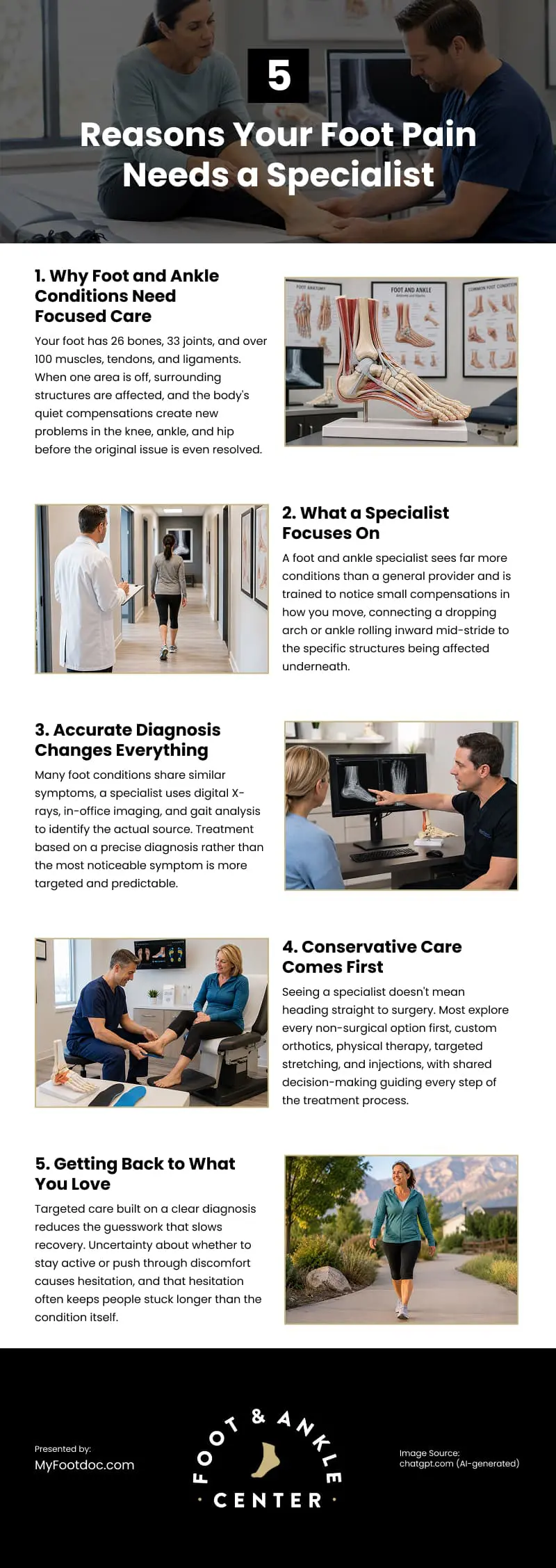
Foot and ankle pain is easy to dismiss at first, but when it keeps coming back or starts affecting daily movement, the complexity often requires more than a general approach. Find out why your foot pain needs a specialist in this infographic.
Sources:
1https://www.ncbi.nlm.nih.gov/sites/books/NBK536941/